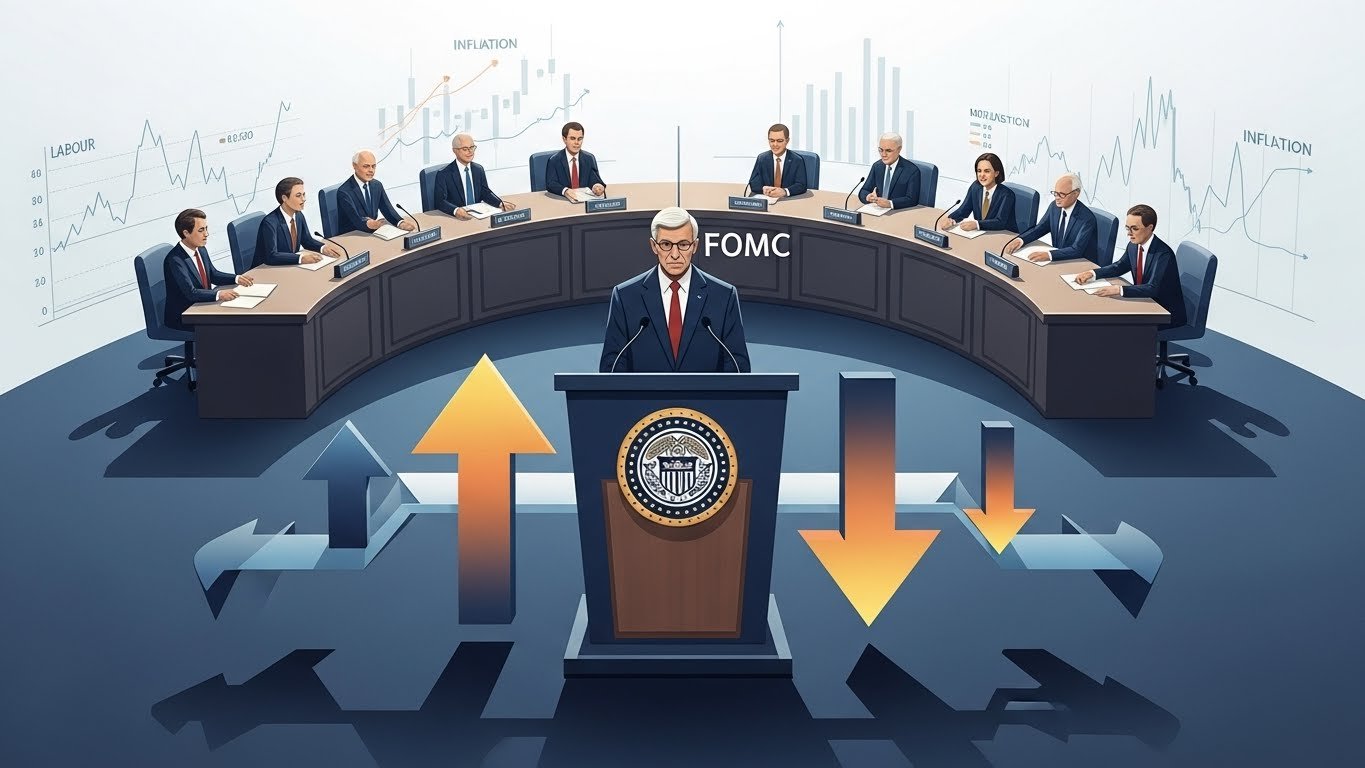
The U.S. economy is showing increasingly mixed signals as the Federal Reserve enacted its third consecutive interest rate cut this month, lowering the benchmark rate to its lowest level in three years. Federal Reserve Chair Jerome Powell and other officials framed the move as necessary to support growth and ease labor market pressures, but persistent inflation and internal dissent highlight ongoing uncertainties about the economic outlook. Investors responded positively with equity markets rallying, yet key indicators including jobless claims and consumer affordability concerns suggest that the recovery remains uneven. As the Fed navigates between elevated prices and cooling labor data, the path for U.S. monetary policy in 2026 remains highly contested, with broader implications for markets, borrowing costs, and consumer confidence. Source: Financial Times, Reuters, and news reporting — summarized and analyzed by TheDollarPulse. Financial Times+2Reuters+2
Key Development
In its final Federal Open Market Committee meeting of 2025, the Federal Reserve voted to reduce the federal funds rate by 0.25 percentage points to a range of 3.5 percent to 3.75 percent, marking the third consecutive cut this year. The decision reflects concerns about slowing job growth and the need to support economic activity, even as inflation remains above the Fed’s long-term target. Three policymakers dissented, the highest level of disagreement in recent years, underscoring internal divisions on the appropriate direction for monetary policy. Source: Federal Reserve FOMC statement — summarized and analyzed by TheDollarPulse. federalreserve.gov
Why It Matters
Rate cuts at a time of uneven economic performance matter because they signal official concern that the economy may not be self-sustaining without accommodative policy. Although inflation has moderated from earlier highs and is closer to the Fed’s 2 percent objective, price pressures still burden many households, particularly in housing, energy, and goods. At the same time, labor market data reveal softness, with weekly jobless claims rising significantly — the largest weekly increase in nearly four and a half years — even as broader unemployment trends remain relatively stable. Source: Reuters reporting on labor data and inflation dynamics — summarized and analyzed by TheDollarPulse. Reuters+1
Market Implications
Financial markets reacted to the rate cut with gains in major stock indexes, as investors interpreted the policy move as supportive of future growth and risk assets. However, the backdrop of persistent inflation and uneven employment figures means market sentiment could shift rapidly if incoming data disappoints. Traders are now pricing in the possibility of only one additional rate cut in 2026, highlighting uncertainty about how much further monetary easing is warranted. Source: Associated market reporting — summarized and analyzed by TheDollarPulse. AP News
Trade and Policy Influences
Trade policy and tariffs remain a significant undercurrent shaping economic sentiment. Tariff-related price increases on imported goods have helped keep consumer costs elevated, feeding into affordability debates among households and policymakers alike. Even as overall inflation trends are expected to slow, persistent price pressures linked to trade measures underscore political and economic tensions that extend beyond central bank decisions. Source: Reuters reporting on inflation outlook — summarized and analyzed by TheDollarPulse. Reuters
TheDollarPulse Analysis
The key takeaway is that the Federal Reserve’s policy trajectory reflects a balancing act between supporting growth and containing inflation that has not yet fully normalized. Continued rate cuts amid lingering inflation pressures suggest the central bank is navigating unprecedented conditions: weak labor signals, mixed price data, and political influences. For investors and households, this dynamic creates both opportunities and risks. Lower borrowing costs can support investment and consumption, but if inflation proves stickier than anticipated, real income pressures may persist, especially for lower- and middle-income consumers. With the Fed’s internal dissent and mixed economic indicators, markets should brace for volatility and shifting expectations as 2026 unfolds.
Sources
Source: Federal Reserve FOMC statement and policy reporting — summarized and analyzed by TheDollarPulse.
Source: Financial Times and Reuters news coverage — summarized and analyzed by TheDollarPulse.
This article contains original analysis and does not reproduce copyrighted text.