
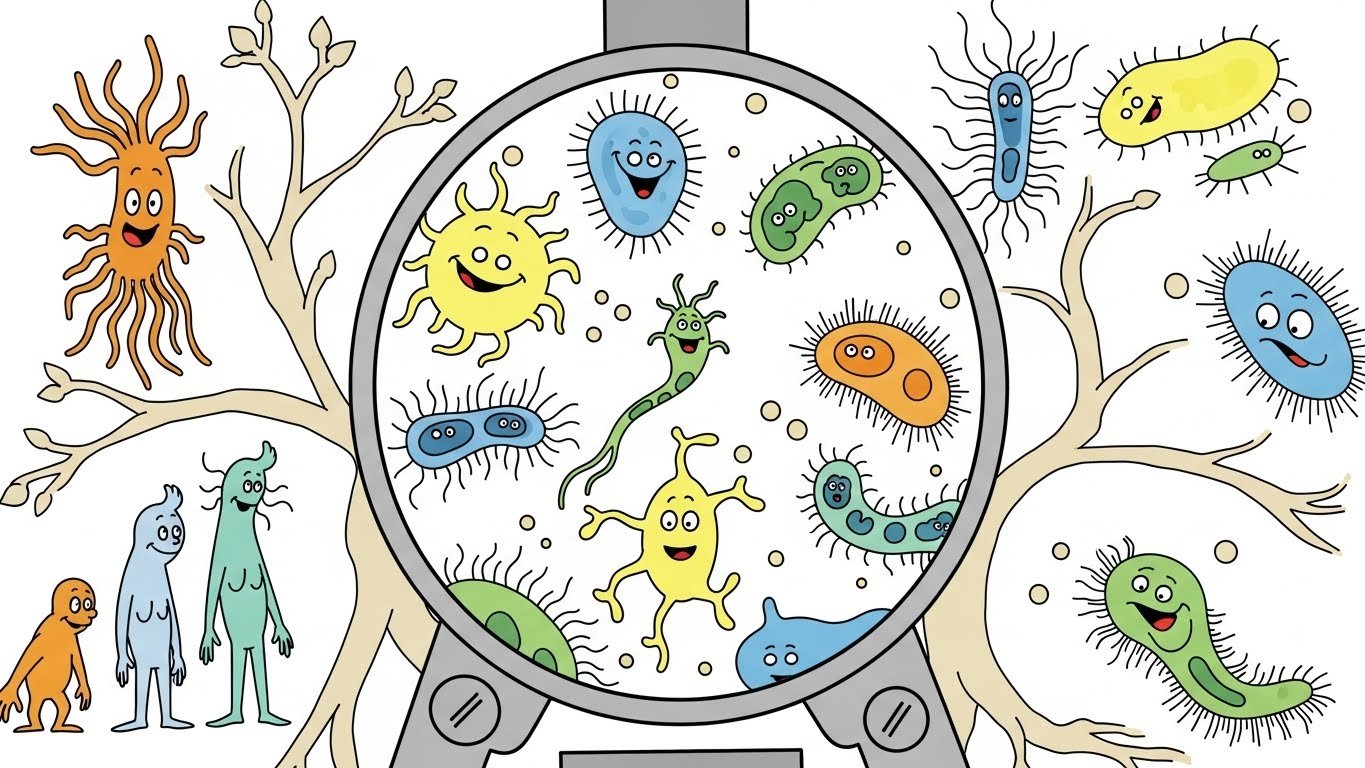
In the muddy sediments beneath ancient seafloors, scientists have discovered a group of unusual microorganisms called Asgard archaea that could hold vital clues to one of biology’s biggest mysteries: how complex life evolved from simple cells. These microbes may help explain how organisms like plants, animals, and fungi first emerged on Earth, offering new insights into the origin of eukaryotic life. Science News
Tiny Organisms, Huge Evolutionary Significance
Archaea are single-celled organisms that, like bacteria, lack a nucleus. But unlike bacteria, some archaea — especially those in a group named Asgard after Norse mythology — possess genetic features that are surprisingly similar to those found in eukaryotes, the domain of life that includes humans and other complex organisms. Science News+1
First identified in sediments from the North Atlantic Ocean about a decade ago, Asgard archaea are thought to have evolved over three billion years ago, making them ancient members of Earth’s earliest ecosystems. Although these microbes are tiny and thrive in low-oxygen environments, their DNA places them close to the base of the evolutionary branch that eventually led to complex life. Science News
How Asgard Archaea May Have Given Rise to Complex Cells
Understanding how eukaryotes — cells with a membrane-bound nucleus — first appeared is one of biology’s biggest unsolved questions. Traditional bacteria and typical archaea do not have features like nuclei or complex internal structures. Yet Asgard archaea show hints of proteins and genes that resemble those involved in more advanced cellular machinery. ScienceDaily+1
Some research suggests that ancient Asgard microbes may have formed symbiotic partnerships with other microbes, eventually leading to the first eukaryotic cells. In this scenario, the host cell and its partner became so intertwined that their genomes and functions became inseparable — laying the foundation for complex life. Science News
Other studies have shown that Asgard archaea harbor eukaryotic-like actin proteins that help form internal cellular structures, as well as rare tubulin-like proteins similar to components of modern cytoskeletons. ScienceDaily These findings suggest that the building blocks for complex cell architecture were present long before eukaryotes evolved.
Implications for Life on Earth — and Beyond
If complex life emerged from organisms like Asgard archaea once, it raises intriguing possibilities about the evolvability of life elsewhere in the universe. Scientists speculate that if the evolutionary steps taken by ancient Earth microbes were not uniquely improbable, then similar processes could occur on other Earth-like worlds where conditions support life. Science News
In addition, uncovering the characteristics and behaviors of diverse Asgard lineages helps scientists refine models of cell evolution, illuminating the transition from simple prokaryotic life to the complex eukaryotic cells that make up all animals, plants, and fungi today. Wikipedia
The Dollar Pulse Analysis
The discovery and ongoing research on Asgard archaea represent a major turning point in understanding the origins of complex life. Unlike simpler organisms, these microbes seem to bridge a critical gap in evolutionary history. Their unique genetic features and potential symbiotic pathways offer plausible scenarios for how eukaryotic cells — the foundation of multicellular life — first took shape.
For science, this means a shift from viewing complex life as a rare accident to considering it a natural outcome of long-term evolutionary processes. As research continues and more Asgard taxa are studied, the narrative of life’s history on Earth — and potentially elsewhere — may be rewritten.
This article contains original reporting and analysis based on publicly available scientific reporting.
Primary referenced reporting:
- Science News, “How these strange cells may explain the origin of complex life,” by Michael Marshall.
Sources are cited for transparency and clarity.