
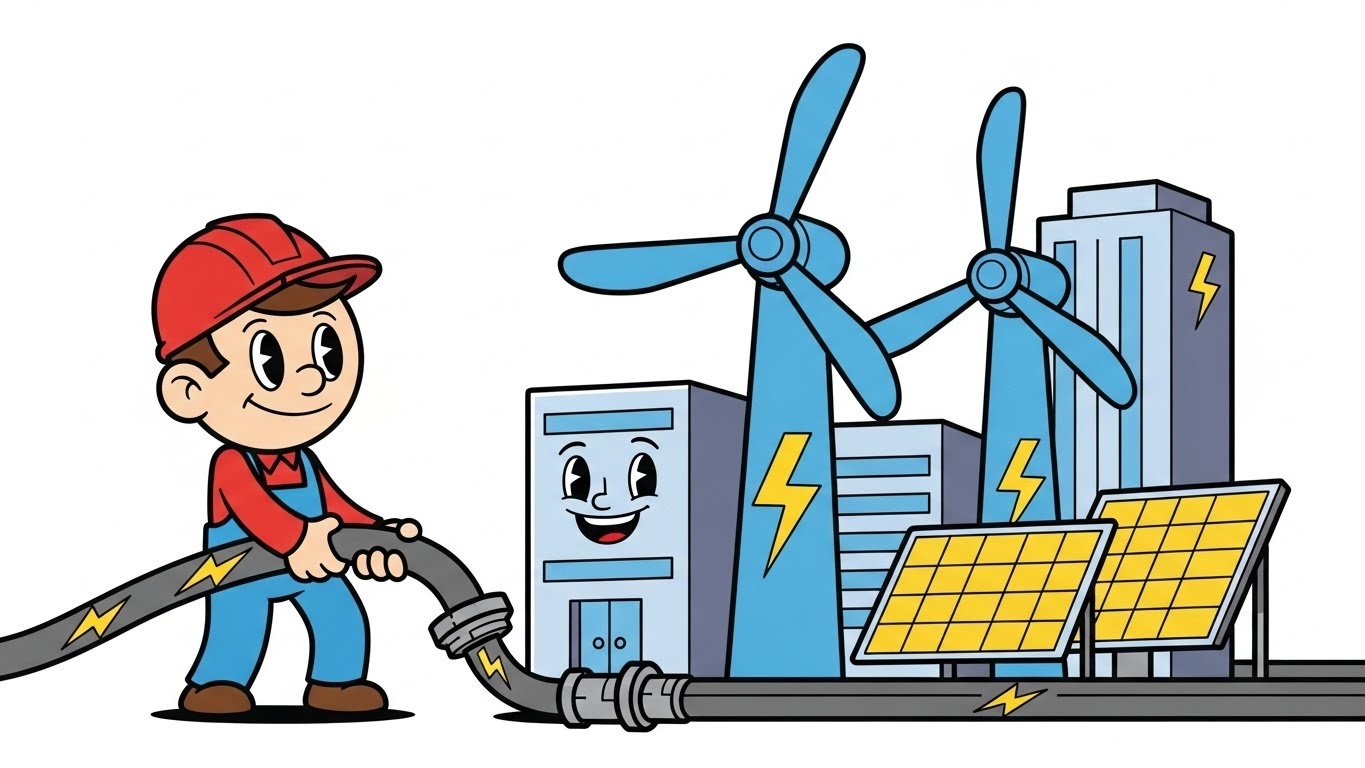
NextEra Energy, one of the largest renewable power producers in the United States, has announced a 15-gigawatt power infrastructure project to supply electricity to Google data centers across the country. The plan, expected to roll out over the next decade, represents a major strategic investment at the intersection of energy production, digital infrastructure expansion, and corporate commitment to sustainability.
(CNBC)
This development reflects how energy economics and technology demand are becoming deeply intertwined, with renewable generation capacity now central to large corporate operations that drive digital growth and cloud computing services.
1. What NextEra’s Expansion Means
NextEra’s project — one of the largest private power contracts ever negotiated for the tech sector — involves:
- constructing 15 gigawatts of generation capacity
- focusing heavily on renewable and low-emission sources
- directly supplying Google’s expanding network of data centers
To put it in perspective, 15 gigawatts is roughly equivalent to the output of multiple large nuclear reactors or dozens of major wind farms. This marks a shift toward long-term, stable power agreements between energy producers and high-consumption tech companies.
2. Energy Meets Tech: A New Economic Frontier
The rise of artificial intelligence, cloud computing, and continuous data processing means data centers are among the fastest-growing energy consumers in the economy. As companies like Google scale their infrastructure:
✔ demand for low-cost, reliable power increases
✔ reliance on renewable generation intensifies
✔ long-term power purchase agreements (PPAs) grow more attractive
For utilities and energy developers, this means a stable revenue pipeline tied to digital growth rather than traditional industrial demand.
3. Macroeconomic Signals to Watch
This partnership signals several broader trends:
Tech Capital Expenditure Shift
Investment is no longer only in servers and facilities — it now involves physical infrastructure at continental scale.
Renewables as Competitive Advantage
Companies with strong sustainability commitments gain:
- lower regulatory risk
- greater investor appeal
- improved carbon profiles
- reduced long-term operating costs
Regional Economic Impact
Solar, wind, and storage projects often create jobs, boost local tax bases, and enhance grid resilience in rural and developing regions.
4. What This Means for Energy Markets
The deal reinforces a growing reality: renewable energy is no longer niche — it is integral to national economic competitiveness. Countries and states that attract large data center investments will also demand:
- improved grid infrastructure
- faster permitting for clean energy projects
- workforce development in tech and energy sectors
This could sharpen economic competition between regions for future corporate investment.
5. The Dollar Pulse Economic Analysis
NextEra’s 15-gigawatt buildout for Google is not merely a contract — it represents a structural shift in the global energy economy:
- Energy producers now compete for long-term corporate partnerships instead of short-term commodity sales.
- Tech companies increasingly internalize energy risk as part of their core operational models.
- Renewable generation capacity becomes central to economic growth strategy, not just environmental goals.
For investors, policymakers, and business leaders, this signals a broader realignment: energy markets and tech markets are converging at scale.
This article contains original reporting and analysis based on publicly available news coverage.
Referenced reporting from CNBC regarding NextEra’s 15-gigawatt project to supply power to Google data centers (Dec. 8, 2025).
Sources are cited for transparency.