
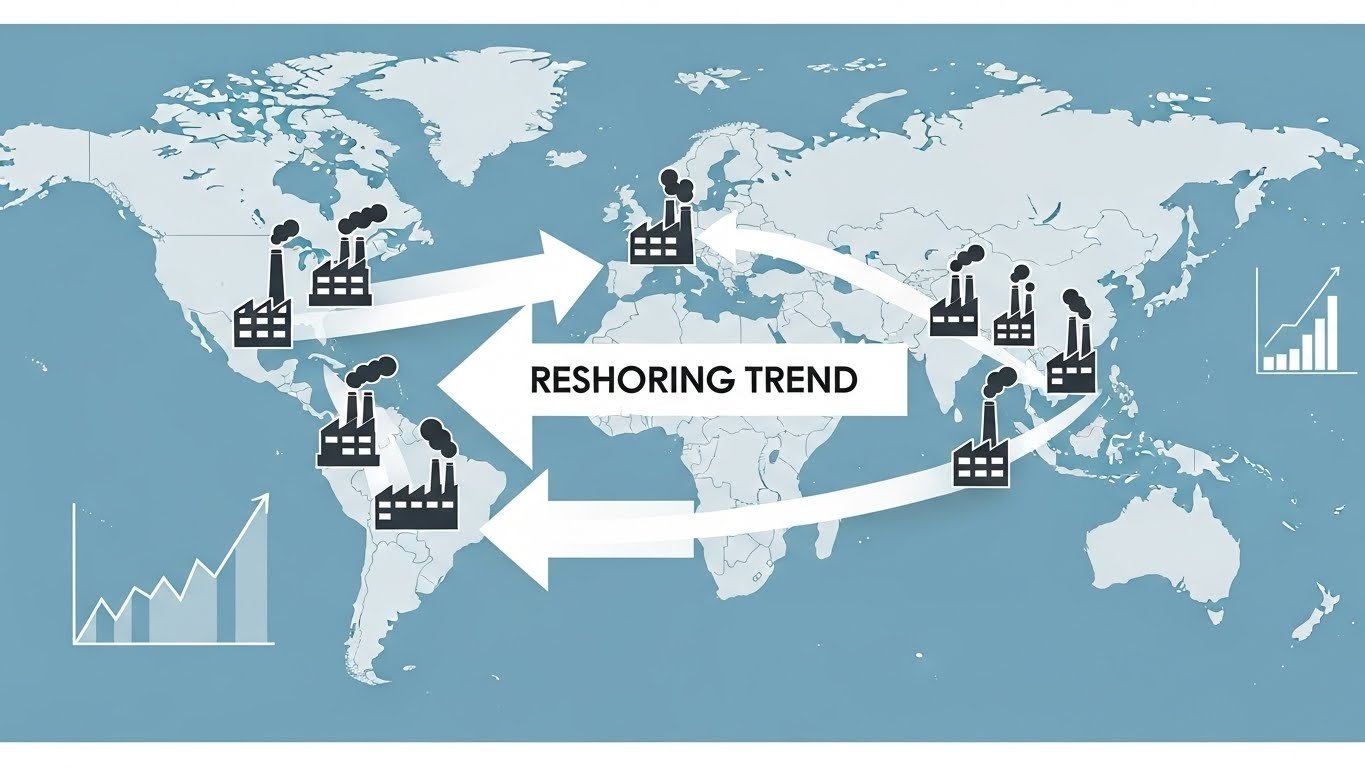
A massive wave of reshoring and nearshoring is reshaping global supply chains as companies accelerate the relocation of factories and high-value production closer to domestic markets.
The trend — once a slow-moving conversation in policy circles — has turned into a global economic transformation driven by geopolitical tensions, supply-chain instability, rising wages in Asia, and rapid advances in AI-driven automation.
From the United States and Europe to Japan, Mexico, Southeast Asia, and Latin America, the world economy is reorganizing around security, resilience, and technological sovereignty rather than low-cost mass manufacturing.
1. Why Reshoring Is Accelerating Now
Several major forces are converging:
Geopolitical Tensions
Tariff conflicts, export bans, and strategic rivalry are pushing companies to reduce exposure to uncertain regions.
Supply Chain Instability
The pandemic exposed vulnerabilities in long, complex global supply networks that depend on single-country production.
AI and Robotics Automation
Advanced automation makes domestic manufacturing cheaper and more competitive, reducing the labor-cost advantage of China and other low-cost hubs.
Government Incentives
The U.S., EU, and Japan are offering tax credits and subsidies for domestic production of everything from semiconductors to pharmaceuticals and critical minerals.
Energy Transition
New industrial capacity must align with clean-energy infrastructure, favoring regions with stable renewable energy supply.
2. The Countries Gaining the Most
United States
Billions in incentives from the CHIPS Act and Inflation Reduction Act are attracting semiconductor, battery, and EV supply chain investment.
Mexico
Now a global nearshoring hotspot for automotive, aerospace, and electronics companies targeting the U.S. market.
India
Positioning itself as an alternative to China for electronics, pharmaceuticals, and textiles.
Southeast Asia
Vietnam, Malaysia, and Indonesia continue to absorb diversified manufacturing flows.
Europe
Germany, Poland, and France are reshoring critical industry segments in energy and advanced manufacturing.
3. Industries Most Affected
The sectors undergoing the largest reshoring shifts include:
- semiconductors
- automotive & EV batteries
- pharmaceuticals & medical supplies
- renewable energy equipment
- consumer electronics
- defense and aerospace
Many companies now integrate “geopolitical risk analysis” directly into supply chain strategy — something virtually unheard of a decade ago.
4. Economic Consequences for 2026 and Beyond
Reshoring brings both opportunities and risks:
Opportunities
✔ stronger domestic job markets
✔ more resilient supply chains
✔ closer integration between R&D and manufacturing
✔ increased investment in automation and robotics
✔ improvement in national security around critical goods
Risks
✘ higher production costs in the short term
✘ potential inflationary pressure
✘ global competition for skilled labor
✘ regional imbalance between industrial winners and losers
Economists predict a multi-year realignment that could define global trade patterns for decades.
5. The Dollar Pulse Economic Insight
This is more than a temporary shift — it is the beginning of a structural reconfiguration of the global economy, where:
- resilience beats efficiency
- diversification beats dependence
- automation beats cheap labor
- regional hubs beat ultra-globalized networks
Companies that adapt early will gain strategic protection and long-term competitive advantage.
The nations that ignore this shift risk falling behind in the next era of industrial power.
This article contains original analysis based on publicly available global economic reports, supply chain surveys, and governmental industrial policy updates.
Sources cited solely for transparency.