
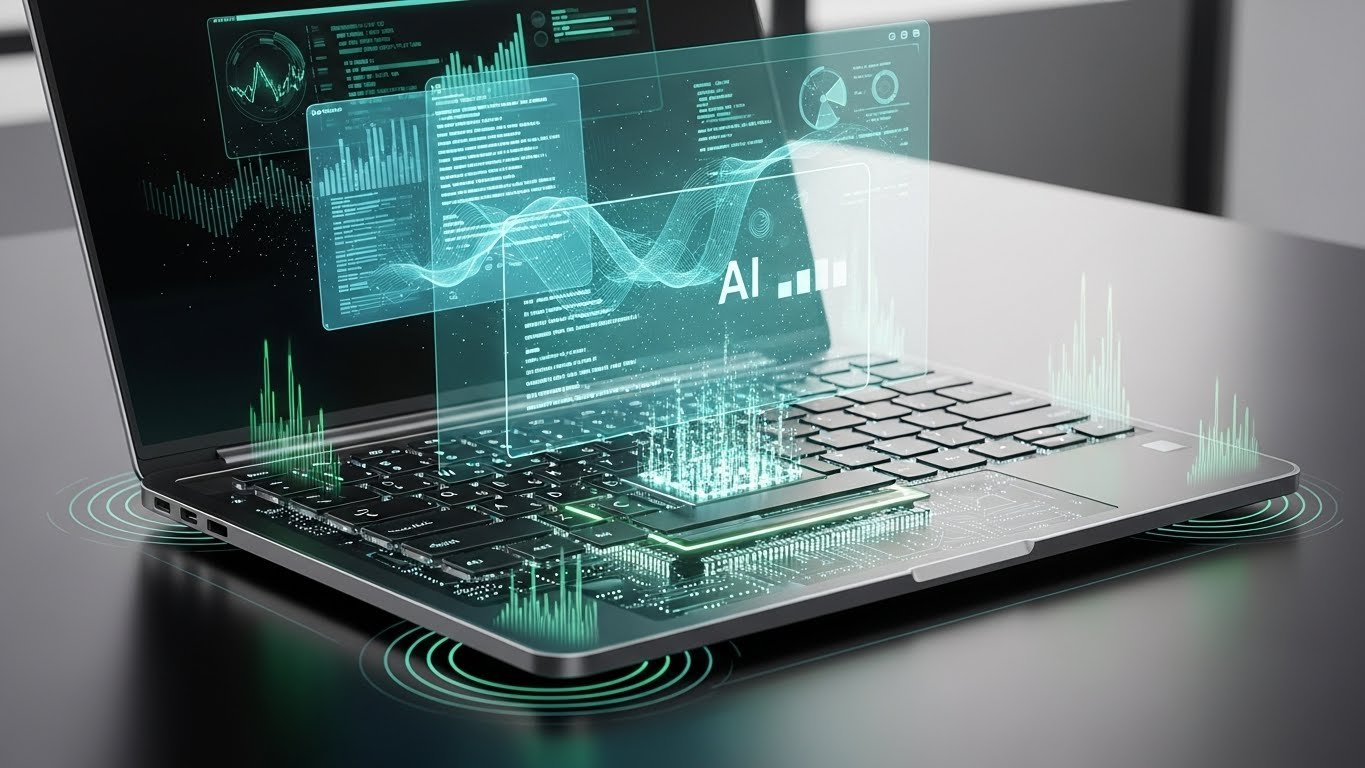
Microsoft has officially unveiled its first generation of “Copilot PCs,” a new class of Windows devices built to run advanced AI models natively through dedicated neural processors. The announcement marks one of the most significant architectural shifts in Windows history, positioning AI as the core layer of the operating system rather than an add-on feature. Early demonstrations showcased real-time document summarization, on-device image generation, predictive task automation, and system-wide natural-language control — all running locally without cloud dependence. Industry analysts say the move intensifies the competition between Microsoft, Apple, and Google as the race for AI-enhanced personal computing accelerates. Source: Microsoft executive briefings and industry reporting — summarized and analyzed by TheDollarPulse.
Key Development
The new Copilot PC lineup integrates next-generation NPUs (Neural Processing Units) capable of trillions of operations per second, allowing Windows to execute large machine-learning workloads directly on the device. Microsoft engineers highlighted that these systems are optimized for hybrid AI — blending edge processing with optional cloud augmentation. The company also introduced a redesigned Windows layer that embeds Copilot into system functions such as search, settings, content creation, and cybersecurity. Early testing presented during the launch showed substantial gains in responsiveness and energy efficiency when handling AI-driven tasks. Source: Tech analyst commentary and launch demonstrations — summarized and analyzed by TheDollarPulse.
Why It Matters
AI-accelerated PCs are expected to redefine productivity, creativity, and workflow automation. Moving intelligence onto the device offers several advantages: enhanced privacy, near-instant processing, offline functionality, and reduced server costs for developers. For consumers, this means tasks previously restricted to the cloud — like video editing enhancements, voice synthesis, code generation, and semantic search — can now run seamlessly at the hardware level. For Microsoft, the launch represents a strategic push to modernize Windows and reclaim innovation momentum in a market increasingly influenced by mobile-centric ecosystems. Source: Industry evaluation of AI PC trends — summarized and analyzed by TheDollarPulse.
Market and Industry Implications
PC manufacturers including Dell, HP, Lenovo, and ASUS are preparing extensive Copilot PC refresh cycles, betting that AI-native hardware will drive one of the strongest upgrade waves since the rise of ultrabooks. Semiconductor partners — particularly Qualcomm and AMD — are competing aggressively to supply next-gen NPUs optimized for these workloads. Investors expect shifts in software monetization as app developers adopt on-device AI models tailored for ultrafast inference. Meanwhile, enterprise IT leaders are evaluating how AI-accelerated PCs can streamline workflows in fields like finance, design, cybersecurity, and data analytics. Source: Market research summaries and OEM disclosures — summarized and analyzed by TheDollarPulse.
TheDollarPulse Analysis
The key takeaway is that Microsoft’s Copilot PCs signal the beginning of a structural transformation in the PC ecosystem. By anchoring the operating system around local AI performance, Microsoft is redefining what personal computing means — pushing the industry toward devices that think, assist, and automate in real time. While long-term adoption will depend on software support and price competitiveness, the shift represents one of the clearest indications yet that AI is becoming a foundational computing layer. Companies that rapidly adapt their hardware, software, and developer tooling to this new model will shape the future of the PC market.
Sources
Source: Microsoft launch briefings, OEM partner reporting, and analyst commentary — summarized and analyzed by TheDollarPulse.
This article contains original analysis and does not reproduce copyrighted text.