
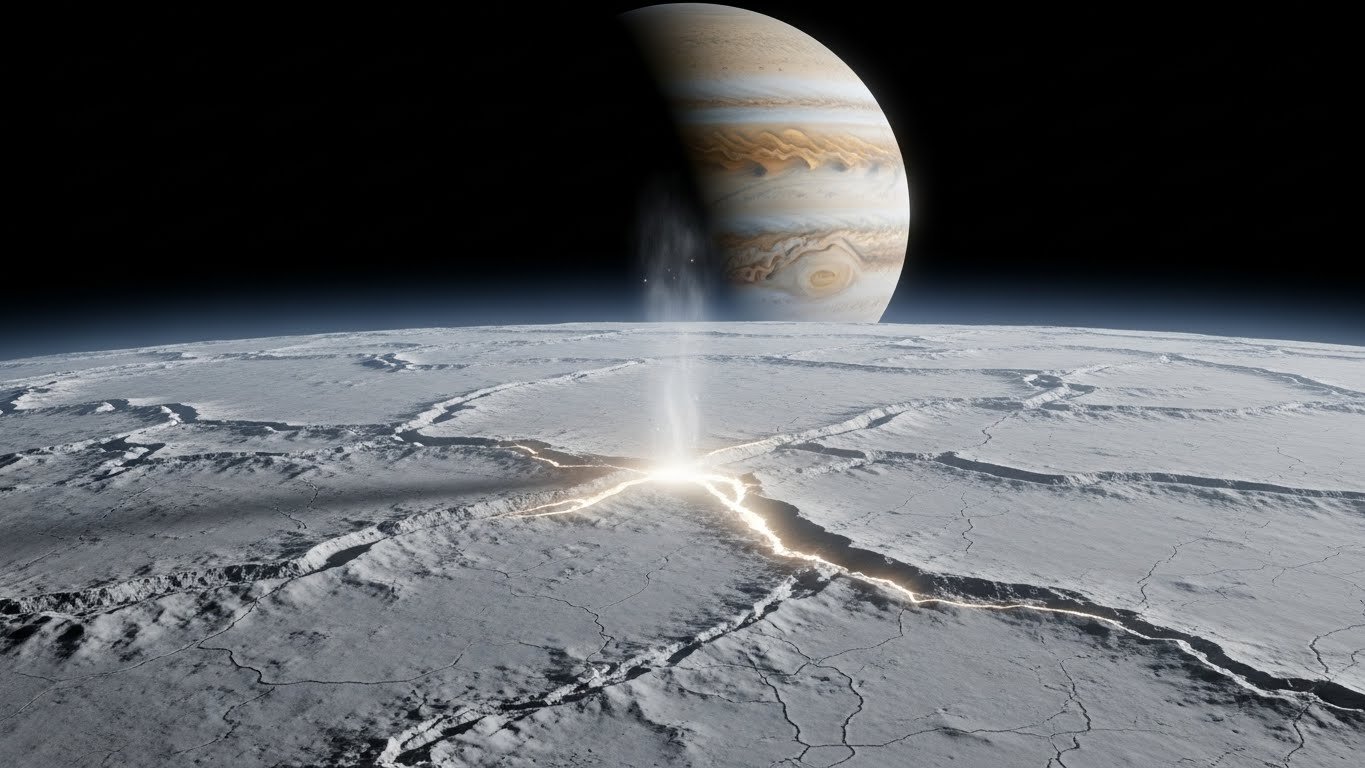
NASA scientists have confirmed the detection of complex organic molecules on the icy surface of Europa, one of Jupiter’s most promising moons for extraterrestrial habitability. The discovery, made using high-resolution spectroscopic data from the Europa Clipper’s early flyby instrumentation, provides the strongest evidence yet that Europa’s subsurface ocean may contain the chemical building blocks necessary for life. While the findings do not confirm biological activity, researchers emphasize that organics of this complexity rarely appear without intriguing geological or chemical processes underneath. The announcement has energized the scientific community and renewed global interest in astrobiology, planetary chemistry, and future life-detection missions. Source: NASA and scientific mission briefings — summarized and analyzed by TheDollarPulse.
Key Development
During a recent observation sequence, scientific instruments detected signatures consistent with long-chain organic molecules embedded in freshly exposed surface ice near Europa’s equatorial fractures. These fractures are believed to be conduits connecting the moon’s subsurface ocean to its frozen crust, potentially transporting oceanic material upward. According to mission scientists, the organic complexity observed exceeds previous detections of simple carbon-based compounds, marking a significant milestone in the search for habitable environments beyond Earth. Source: NASA Clipper science team reports — summarized and analyzed by TheDollarPulse.
Why It Matters
Europa has been considered one of the most promising locations for extraterrestrial life due to its vast internal ocean, thought to contain more than twice the water volume of Earth’s oceans. The presence of complex organics strengthens this profile by indicating active chemical processes capable of generating precursors to biological systems. For astrobiologists, this discovery narrows the gap between environmental potential and measurable life-supporting chemistry. For policymakers and space agencies, it adds momentum to missions focused on exploring Europa’s ocean and assessing its biological viability. Source: Astrobiology community analysis — summarized and analyzed by TheDollarPulse.
Scientific Implications
The detection suggests that Europa’s ocean may be interacting with its rocky mantle, creating chemical gradients similar to those that could have supported early microbial life on Earth. Scientists are now prioritizing follow-up observations to determine whether the organics originate from hydrothermal vents, geological resurfacing, or abiotic chemical synthesis triggered by radiation. The next set of flybys will target higher-resolution sampling zones to build a fuller picture of Europa’s chemistry and its potential to host living systems. Source: Planetary science briefings — summarized and analyzed by TheDollarPulse.
TheDollarPulse Analysis
The key takeaway is that Europa is increasingly emerging as a prime candidate in the search for life within our solar system. While this discovery does not constitute evidence of biology, it significantly elevates the scientific stakes by confirming that Europa’s ice shell contains complex organic material likely linked to its subsurface ocean. As the Europa Clipper mission advances, investors, scientific institutions, and global space agencies have strong incentive to deepen exploration efforts, with the potential payoff being one of the most consequential scientific discoveries in human history: signs of life beyond Earth.
Sources
Source: NASA science mission briefings and Europa Clipper research updates — summarized and analyzed by TheDollarPulse.
This article contains original analysis and does not reproduce copyrighted text.