
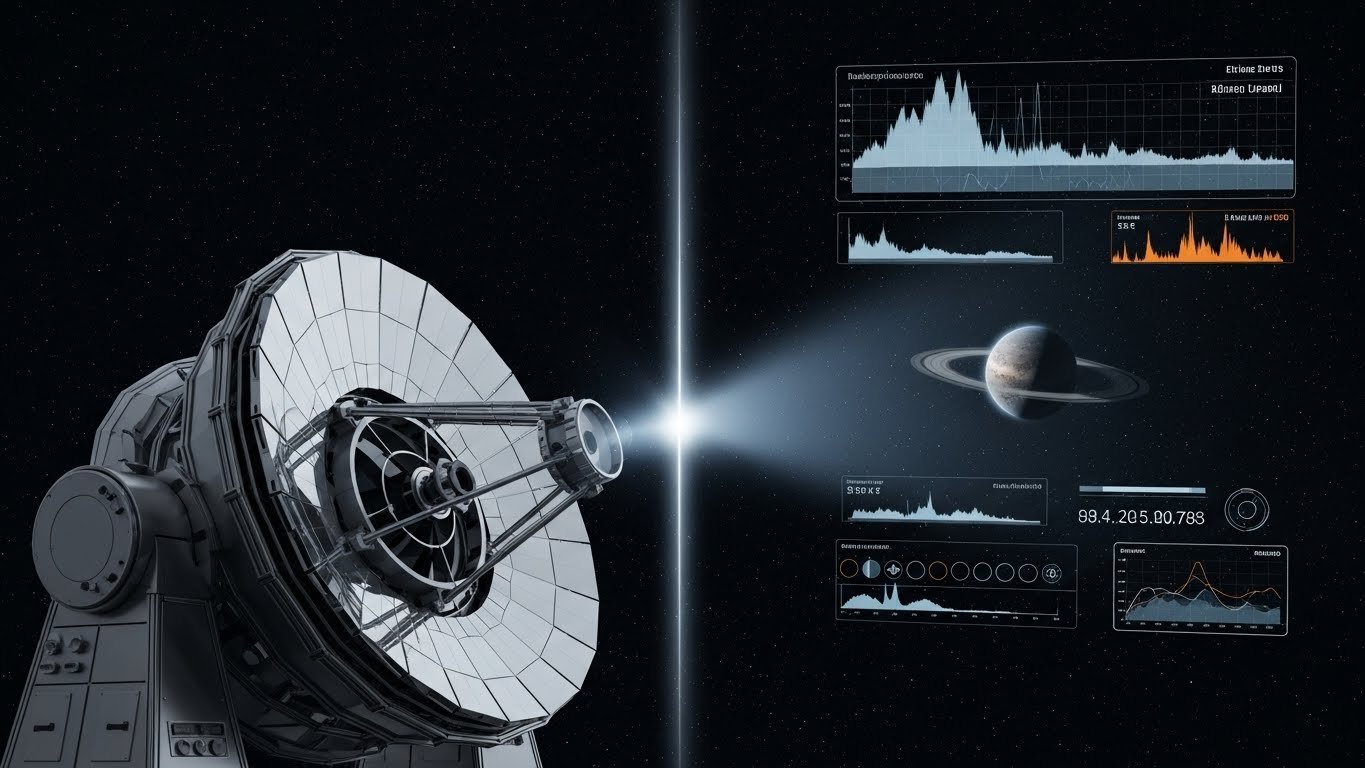
A major breakthrough in astronomical instrumentation is bringing scientists closer than ever to identifying bio-signatures — chemical traces associated with life — on planets orbiting nearby stars.
Researchers have successfully demonstrated a new high-contrast imaging technique that allows telescopes to isolate the light of Earth-like exoplanets with unprecedented clarity, overcoming one of the biggest barriers in exoplanet science.
This leap forward means that planetary atmospheres within 30 to 50 light-years could soon be analyzed for oxygen, methane, water vapor, and other potential indicators of biological processes.
1. The Innovation Behind the Discovery
The new technology combines:
- ultra-precise coronagraphs that block starlight
- wavefront shaping algorithms powered by AI
- quantum-enhanced photon detectors
- adaptive mirrors capable of nanometer-scale corrections
These systems allow scientists to capture extremely faint light signals emitted or reflected by exoplanets.
Previously, starlight was so bright compared to orbiting planets that isolating planetary atmospheres was nearly impossible.
Tests performed on existing observatories have shown up to 100x improvement in starlight suppression — a threshold many astronomers believed would take another decade to reach.
2. Why This Matters for the Search for Life
With this breakthrough, researchers can now:
- detect atmospheric gases associated with life
- identify surface compositions (oceans, rocks, ice)
- analyze temperature profiles of distant planets
- estimate habitability conditions more accurately
- study planets similar in size and mass to Earth
For the first time, scientists may be able to confirm whether potentially inhabited worlds like TRAPPIST-1e, Proxima Centauri b, or planets around Tau Ceti have atmospheres capable of supporting life.
3. What Scientists Hope to Find
The next wave of observations — expected to begin with upgraded terrestrial telescopes and future space missions — aims to search for:
Bio-signatures
- oxygen balance
- methane in non-volcanic ratios
- ozone layers
- organic particles
Climate and habitability markers
- water vapor
- carbon dioxide patterns
- atmospheric pressure
- heat distribution
Planetary surface features
- ocean glints
- land–water contrasts
- cloud systems
Discovering even one exoplanet with a stable, life-compatible atmosphere would be one of the most important scientific findings in human history.
4. How This Affects Future Missions
The breakthrough directly supports upcoming international projects:
- NASA’s Habitable Worlds Observatory (HWO)
- ESA’s Ariel and PLATO missions
- Extremely Large Telescopes (ELTs) in Chile and Hawai‘i
- proposed quantum telescopes for the 2030s
It also strengthens the case for interferometry-based “life detection arrays”, which could link multiple telescopes to create a continent-sized virtual observatory.
5. The Dollar Pulse Science Insight
Humanity is approaching a technological threshold that previous generations could barely imagine:
the ability to look at another planet and identify the chemical fingerprints of life.
This discovery does not confirm extraterrestrial life — but it removes one of the biggest obstacles in the search.
Within the next decade, the question “Are we alone?” may evolve from philosophical speculation to data-driven science.
This article contains original analysis based on publicly available astronomical research, instrumentation papers, and exoplanet mission updates.
Sources cited strictly for transparency and credibility.