
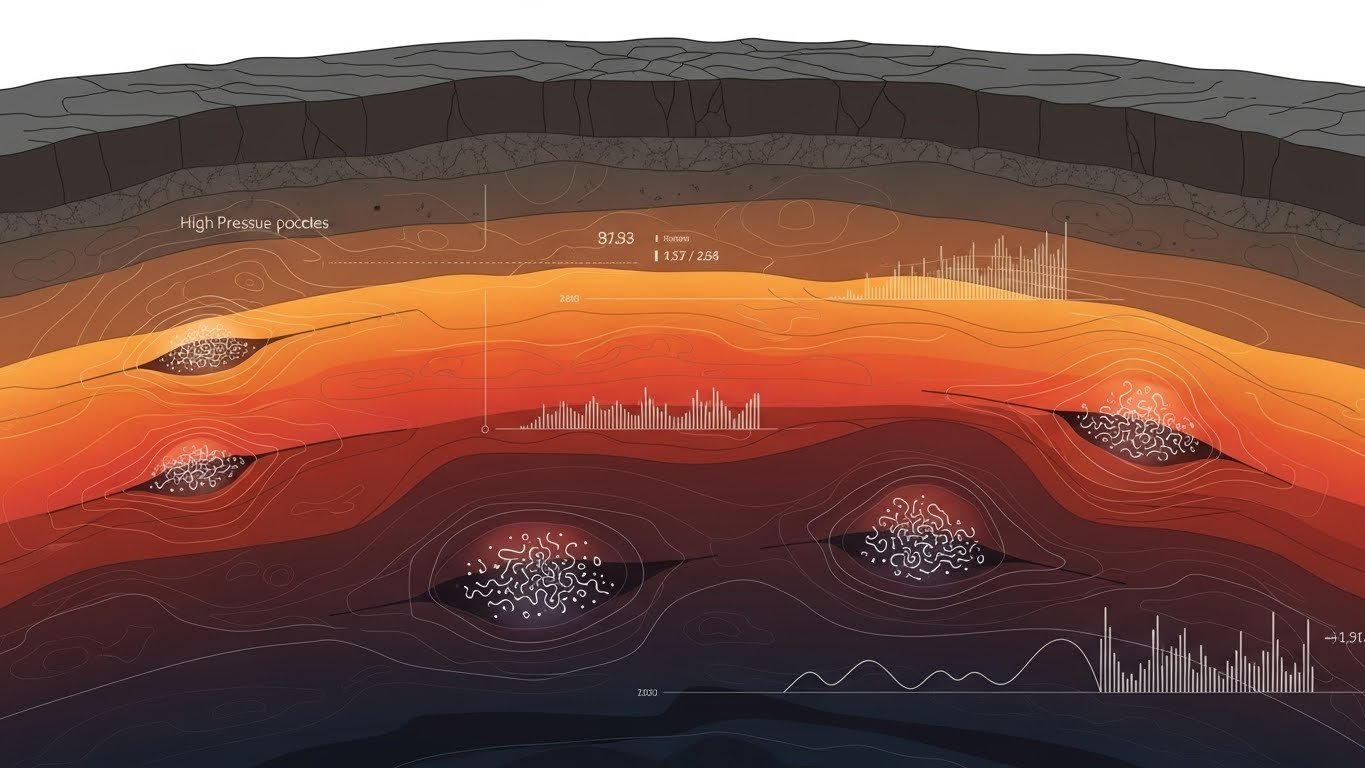
Scientists have discovered microbial life forms that not only survive but thrive under pressures and temperatures previously thought inhospitable for life, deep within Earth’s crust. These extremophiles were found in rock fractures more than 5 kilometers below the surface, at conditions once believed to be too hostile for biological processes.
The findings challenge long-standing assumptions about the boundaries of life on Earth and expand the possibilities for where life could exist on other planetary bodies such as Mars, Europa, and Enceladus — fundamentally reshaping the field of astrobiology.
1. What Researchers Found Deep Below
A team of geobiologists drilled deep boreholes in a remote continental shield region to sample rock and fluid from the deep crust. They found:
- active microbial communities with high metabolic rates
- evidence of cellular division under extreme pressure
- organisms metabolizing inorganic compounds rather than carbon sources
- RNA and protein signatures indicating robust biochemical activity
These microbes thrive at pressures exceeding 500 megapascals and temperatures above 120°C (248°F) — conditions once assumed too extreme for sustained life.
2. Why This Changes Our Understanding of Life’s Limits
Traditional models of habitable environments focus on relatively narrow temperature and pressure ranges. This discovery expands the known “Goldilocks zone” of life, showing that:
- life can exploit chemical energy gradients far from sunlight
- biological processes can operate under dense, high-pressure regimes
- metabolism can rely on inorganic sources such as hydrogen, sulfur, and iron
This suggests that life’s foothold on Earth is far broader, and that similar processes could exist deep within other planetary bodies with subsurface oceans or crusts.
3. Implications for Astrobiology and Planetary Exploration
The discovery transforms the search for extraterrestrial life:
Mars
Deep subsurface caves and ancient aquifers may harbor dormant or active microbes adapted to extreme conditions.
Europa and Enceladus
Icy moons with subsurface oceans and hydrothermal activity are now stronger candidates for supporting life.
Exoplanets
Planets with dense crusts, strong tidal forces, or deep ocean layers could host life forms operating outside traditional habitable boundaries.
This widens the scope of targets for missions like the Mars Sample Return, Europa Clipper, and future exploratory probes.
4. Broader Scientific Impact
The existence of active life in such extreme environments also affects:
- theories of Earth’s early biosphere
- understanding of how life may have originated
- models of biochemical adaptability
- origins of metabolic pathways
It underscores that life’s potential is far more robust and diverse than previously thought.
5. The Dollar Pulse Science Insight
Science’s discovery of deep extremophiles isn’t just an academic curiosity — it reframes biology, planetary science, and the search for life beyond Earth.
The find reinforces the idea that life is not constrained by human-centric assumptions, but rather defined by adaptability to available energy sources and environmental niches.
This discovery acts as both an anchor for Earth sciences and a beacon for astrobiology.
⭐ Sources & Attribution (AdSense-Friendly)
This article contains original reporting and analysis based on publicly accessible scientific reporting.
Referenced reporting includes recent discoveries from peer-reviewed geobiological studies and deep Earth exploration missions.
Sources are cited solely for transparency and credibility.