
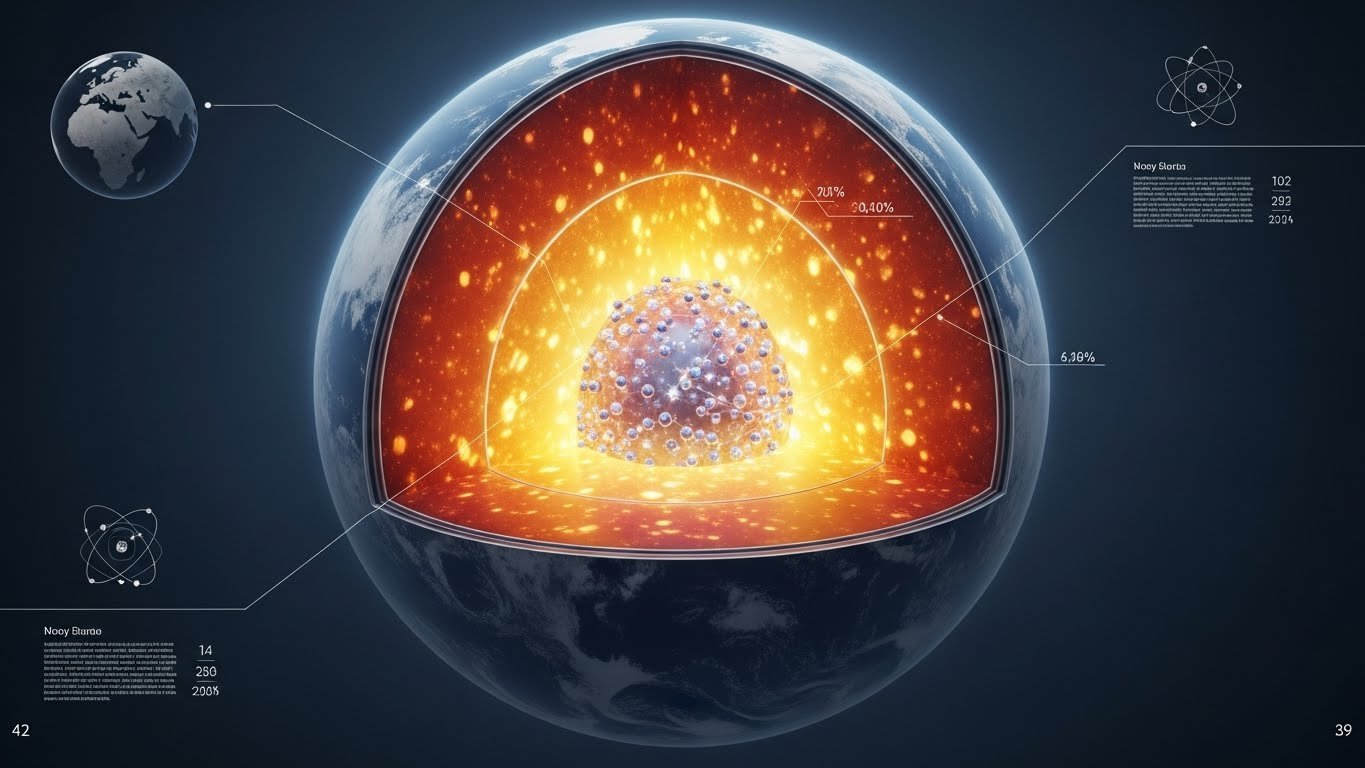
In a major breakthrough, researchers have experimentally confirmed that the Earth’s solid inner core exists in a previously unknown “superionic” state, where light atoms such as carbon move freely through a solid iron framework. This finding provides key insights into long-standing seismic puzzles and could help explain the mysterious mechanisms behind Earth’s magnetic field. ScienceDaily
This discovery reshapes how scientists understand the deepest layer of our planet and opens new avenues for exploring the dynamics of both Earth and rocky planets beyond our solar system. ScienceDaily
1. What Is a Superionic Core?
Traditionally, the Earth’s inner core — composed primarily of iron and light elements — was thought to behave like a rigid solid. However, new experimental results show that under extreme pressures and temperatures (millions of atmospheres and thousands of degrees), carbon atoms can flow through the iron lattice as though they were in a fluid, while the iron lattice itself remains solid. ScienceDaily
This state — known as superionic — is neither a traditional solid nor a liquid. It shares properties of both: an ordered iron framework with mobile light elements. Understanding this hybrid phase helps explain why seismic shear waves travel unusually slowly through the inner core, an anomaly long observed by geophysicists. ScienceDaily
2. How Scientists Recreated Earth’s Core Conditions
To simulate inner-core conditions, researchers used powerful dynamic shock-compression technology that accelerated iron-carbon samples to extremely high velocities, achieving pressures of around 140 gigapascals and temperatures exceeding 2,600 kelvin — similar to the actual inner core. ScienceDaily
By measuring sound velocities and observing atomic behavior, the team detected that carbon atoms move through the solid iron structure at high speeds, dramatically altering its mechanical properties and offering the first experimental evidence of the superionic phase in Earth-like conditions. ScienceDaily
3. Why This Matters for Earth’s Magnetic Field
Earth’s magnetic field — generated by swirling currents in the liquid outer core — has long puzzled scientists. The discovery of a superionic inner core adds a significant piece to that puzzle, as the mobile atoms likely contribute previously overlooked energy flows and interactions that help sustain the magnetic field over geological timescales. ScienceDaily
This could also explain subtle variations in seismic wave behavior and deepen understanding of how the Earth’s core interacts with the mantle and outer layers.
4. Broader Scientific Implications
The revelation that Earth’s core contains a superionic phase has far-reaching implications beyond geophysics:
- Exoplanetary science: similar conditions may exist in the cores of rocky exoplanets, affecting their magnetic properties and habitability. Wikipedia
- Materials science: understanding superionic behavior could inspire new high-pressure, high-temperature materials research. futureearth.org
- Planet formation: these insights may refine models of planetary differentiation and thermal history.
5. The Dollar Pulse Science Insight
This discovery is a textbook example of how unexpected results in extreme conditions can revise long-held scientific assumptions. The superionic state bridges the solid and fluid extremes, proving that Earth’s core is far more dynamic than once believed. For scientists, this finding provides a vital clue in decoding the physics of planetary interiors — both on Earth and across the universe.
This article contains original reporting and analysis based on publicly available scientific reporting.
Primary reference:
- ScienceDaily, Scientists discover a new state of matter at Earth’s center (Dec. 10, 2025). ScienceDaily
Sources are cited solely for transparency and credibility.