
Most people think good credit comes from paying bills on time.
And while that matters, it’s only one part of how credit scoring systems actually work in 2026.
Top performers — people with 750+ scores who consistently get approved for premium cards, low interest rates, and high credit limits — follow a strategy almost nobody talks about:
They manage their utilization cycle, not just their balance.
This single habit can raise your score faster than almost anything else, and it works whether you’re rebuilding credit or trying to break into elite tiers.
⭐ What Is a Utilization Cycle?
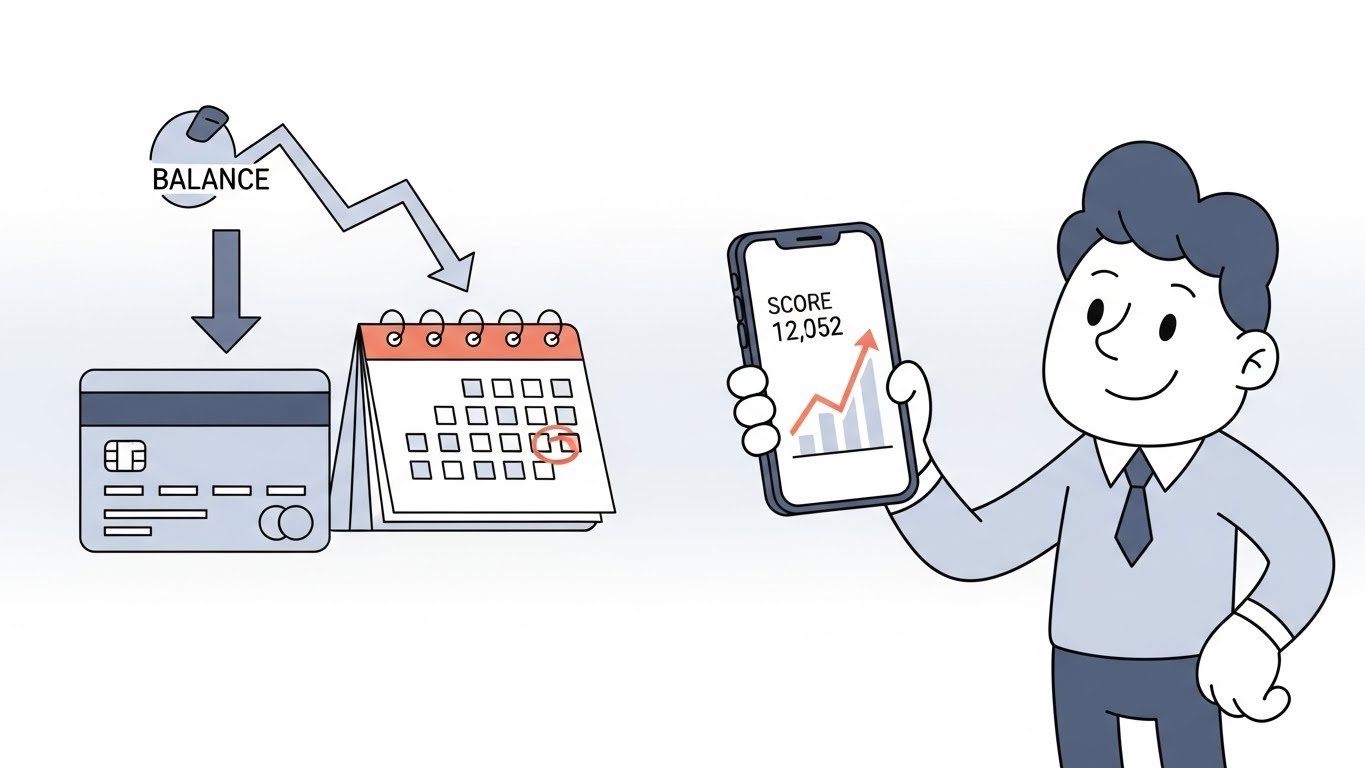
Credit bureaus don’t see your balance in real time.
Instead, they see whatever your credit card company reports on a specific date — usually your statement closing date, not your due date.
This means:
- You can pay your balance on time
- Avoid interest
- Stay responsible
…and still have a low credit score if your utilization is high on reporting day.
High performers understand this and time their payments strategically.
⭐ The Technique: “Pre-Statement Clearing”
Here’s the strategy:
Step 1 — Find your card’s statement closing date
Not the due date — the closing date.
This is when your balance is “captured” and sent to credit bureaus.
Step 2 — Pay down your balance 48 hours before the closing date
Not to zero — just enough to bring your reported utilization below:
- <10% for excellent credit
- <30% for good credit
- <50% for rebuilding credit
Step 3 — Let the small remaining balance report
Credit bureaus prefer to see activity, not zero usage.
Step 4 — Pay the rest by the due date to avoid interest
This keeps your score high and avoids paying a cent in interest.
⭐ Why This Strategy Works in 2026
Credit algorithms in 2026 place even more weight on:
- balance patterns
- high-spend spikes
- internal bank risk scores
- your revolving utilization trends
Paying attention to timing means you control the number the bureaus see — the number that determines approvals, limits, and interest rates.
High spenders benefit the most
Even if you charge $3,000 a month, if your card reports only $200 at closing, your score rises instead of falling.
⭐ The Hidden Advantage: Higher Limits Over Time
Banks use internal metrics that reward:
- low reported utilization
- consistent payoffs
- responsible rotations across multiple cards
When you follow the utilization cycle strategy for 3–6 months, banks often:
- increase your limits
- offer lower APRs
- pre-approve you for premium cards
- trust you with higher spending capacity
This is why high performers always seem to get better offers.
⭐ Real Example
Imagine someone spends $1,500 a month on a $3,000 limit card.
If they let the statement close at $1,500, their utilization reports at 50% — damaging.
But if they pay $1,350 two days before closing:
- the card reports only $150
- utilization becomes 5%
- score increases
- future approvals get easier
Same spending.
Different timing.
Massive difference.
FAQs
Does this work with multiple cards?
Yes — apply the cycle to each card individually.
Will this lower my debt?
You’ll still repay the same amount, but your score rises because utilization drops.
Can this help if my credit is bad?
Absolutely. Utilization control is one of the fastest credit repair tools.
Conclusion
Credit scoring is not just about paying your bills — it’s about understanding the system’s timing.
Master your utilization cycle, and you’ll unlock the financial advantages most consumers never experience:
- higher scores
- better approvals
- bigger limits
- lower interest rates
This is the strategy that separates average borrowers from high-performance credit users in 2026.